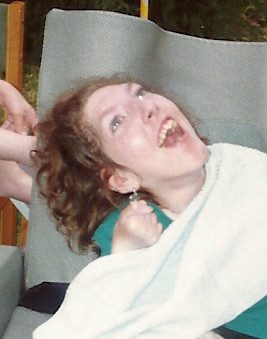
Maree was one of those unfortunate children born with a developmental disability. The most likely diagnosis would be cerebral palsy but in her case the developmental complications were more severe. For example cortical tests showed that she was supposed to be blind.
The disability must have been noticeable at an early age because she was placed in care when quite young. Her parents obviously made the decision to abandon her completely. This was not uncommon at that time. Parents were often advised by doctors and institutions that this was the best course of action to take. Such attitudes can seem hard to understand these days. However, some of the reasons behind this kind of thinking, at that time, would have been; that siblings and the rest of the family would suffer because of the demands that supporting Maree would entail. There would have been the social stigma of having a child with a disability; it was often assumed that the cause was genetic. Also social implications because of Maree’s condition her family would be thought to have bad blood and this would in turn affect the marriage prospects of any siblings. It could also simply be that her mother was single and just could not manage to support Maree. For possible reasons such as these a decision was made to break all contact with Maree. Not all parents did this of course some asked to be kept in touch and others were more involved.
As an example of the attitudes Maree’s family had to deal with; I was told by the grandparents of another lady how when they visited at Maree’s institution they were asked into the office and told by the Matron that they were not doing their granddaughter any good by visiting every weekend. They were told that she would cry for several days after they left and would just about settle down by the time they next visited. Then staff would have to deal with the sobbing all over again. They felt awkward and stopped visiting her.
It’s not surprising then that Maree was abandoned. When she died attempts were made to find out if she had any relatives. But there was nothing on any of her early records that were available. When writing this another attempt to access her records was made. We were informed that as we were not family and as ex-care givers we would not be given access. Any files would not be made public for decades and policies made it likely they will be destroyed. For this reason I decided to write and leave this brief record of Maree’s life here.
Maree was placed in an institution called Ru Rua that had taken over Estcourt House. The grand old house on military road was used mostly for office space. Red brick wards had been added in the grounds. Perhaps its only redeeming feature was that its rear lawns backed onto the dunes and beach. Otherwise it was a pretty run down and depressing place that Maree was placed into. Clients slept in hospital cots in the wards; they basically were living their lives in a hospital. Their home was dominated and run by medical routines and needs. They shared most things including their clothes. They had no privacy at all even in bathrooms and toilets. When this institution was opened there was little appreciation of the needs or awareness of people like Maree. But by the time I arrived in 1989 the place was in the process of being closed. Maree and all her companions were being placed in ordinary homes scattered in the community of Adelaide. Maree moved to a house in Barramundi Drive Hallett Cove. This was where I got to know her over many years.
The move radically changed life for Maree and her companions. She had her own room for the first time in her life. She went out five days a week to partake in day activities. A far cry from the conditions of her first home where many of the clients spent much of the day in their cots or sitting in a crowded day room waiting to be fed meals from a kitchen they never saw. In her new home she would take turns in visiting the supermarket to buy her food and household goods. Maree became well loved by many of her carers. They assisted her to buy her own clothes and personal possessions and to paint and decorate her own room. She even had a pet kitten Smokey which seemed to have a preference for her company.
Several incidents showed that Maree had a good comprehension of her surroundings to those who spent time with her. For example, sitting in the kitchen observing the dinner being cooked the carer said the eggs are burning. Maree started to chuckle. The carer said, “You can laugh you’re going to have to eat it.” Whereupon Maree broke into big belly laughs. The point; you can’t laugh at such a statement unless you have seen the funny side of it.
Many people can’t understand how someone like Maree can give anything to others. This is what she gave to me on her death. I arrived on Easter morning to give her and her housemates their Easter eggs. I entered her room and commented to the palliative care nurse that she looked good. Maree had been quite ill for some months after some medical treatments that had not gone well. The complications had damaged her lungs. She was on oxygen to make her more comfortable. I thought that her improved colour meant she was holding her own. The nurse however turned and said to me that she had been unconscious for hours. He then said that sometimes improved colour could mean she was near the end because it was caused by the blood flushing into the skin.
Her key worker was there and we discussed how after talking recently with another staff member, who had lost a son, we had decided to tell her it was OK to go if we thought it was right. This was because the other staff had told us how sometimes people would struggle to hang on to life for the sake of the people they loved. The key worker had to take another housemate to visit their mother so I said I would sit with her until she got back and would tell her. She left and I sat with her; holding Maree’s hand surreptitiously; feeling her weak pulse. I said gently to her that everybody loved her and wanted her around very much but if it was all too hard then it was okay for her to go. Just like having a long deep sleep and that we would all be sad but that we would all understand. When I said this she turned her head on the pillow; opened her eyes and looked directly into my the eyes, for a few moments. Then she closed her eyes and turned back to rest her head in the pillow. I felt her pulse falter and become extremely faint. Her breathing became almost inaudible, pausing ever longer between breathes.
Her key worker entered the room as I felt the last gentle beat of her heart. It had taken almost an hour from the time I told her it was okay. But the most remarkable thing was the way she had made eye contact with me in a way she had not done before. I remembered how I had sat with her while doctors had measured her brainwaves and pronounced her blind because she registered no electrical activity in her visual cortex. She had never seemed to be blind to me and other staff who knew her well so perhaps this confirmed why we all felt like this. Maree’s final gift to me was to teach me that we can have some control over our death and that we could perhaps choose the time and place to go in a peaceful way. The carer who had lost his son had also been right in his observation that we often struggle to live for the sake of those we love.
Maree gave me something in those moments she taught me how I would wish and hope to die. And that the love and care we have for others counts for more than anything else in life. It’s perhaps the most important gift anyone could give to another. Maree will always be remembered by those who knew her.

Who Was Maree Johnstone.
Maree was one of those unfortunate children born with a developmental disability. The most likely diagnosis would be cerebral palsy but in her case the developmental complications were more severe. For example cortical tests showed that she was supposed to be blind.
The disability must have been noticeable at an early age because she was placed in care when quite young. Her parents obviously made the decision to abandon her completely. This was not uncommon at that time. Parents were often advised by doctors and institutions that this was the best course of action to take. Such attitudes can seem hard to understand these days. However, some of the reasons behind this kind of thinking, at that time, would have been; that siblings and the rest of the family would suffer because of the demands that supporting Maree would entail. There would have been the social stigma of having a child with a disability; it was often assumed that the cause was genetic. Also social implications because of Maree’s condition her family would be thought to have bad blood and this would in turn affect the marriage prospects of any siblings. It could also simply be that her mother was single and just could not manage to support Maree. For possible reasons such as these a decision was made to break all contact with Maree. Not all parents did this of course some asked to be kept in touch and others were more involved.
As an example of the attitudes Maree’s family had to deal with; I was told by the grandparents of another lady how when they visited at Maree’s institution they were asked into the office and told by the Matron that they were not doing their granddaughter any good by visiting every weekend. They were told that she would cry for several days after they left and would just about settle down by the time they next visited. Then staff would have to deal with the sobbing all over again. They felt awkward and stopped visiting her.
It’s not surprising then that Maree was abandoned. When she died attempts were made to find out if she had any relatives. But there was nothing on any of her early records that were available. When writing this another attempt to access her records was made. We were informed that as we were not family and as ex-care givers we would not be given access. Any files would not be made public for decades and policies made it likely they will be destroyed. For this reason I decided to write and leave this brief record of Maree’s life here.
Maree was placed in an institution called Ru Rua that had taken over Estcourt House. The grand old house on military road was used mostly for office space. Red brick wards had been added in the grounds. Perhaps its only redeeming feature was that its rear lawns backed onto the dunes and beach. Otherwise it was a pretty run down and depressing place that Maree was placed into. Clients slept in hospital cots in the wards; they basically were living their lives in a hospital. Their home was dominated and run by medical routines and needs. They shared most things including their clothes. They had no privacy at all even in bathrooms and toilets. When this institution was opened there was little appreciation of the needs or awareness of people like Maree. But by the time I arrived in 1989 the place was in the process of being closed. Maree and all her companions were being placed in ordinary homes scattered in the community of Adelaide. Maree moved to a house in Barramundi Drive Hallett Cove. This was where I got to know her over many years.
The move radically changed life for Maree and her companions. She had her own room for the first time in her life. She went out five days a week to partake in day activities. A far cry from the conditions of her first home where many of the clients spent much of the day in their cots or sitting in a crowded day room waiting to be fed meals from a kitchen they never saw. In her new home she would take turns in visiting the supermarket to buy her food and household goods. Maree became well loved by many of her carers. They assisted her to buy her own clothes and personal possessions and to paint and decorate her own room. She even had a pet kitten Smokey which seemed to have a preference for her company.
Several incidents showed that Maree had a good comprehension of her surroundings to those who spent time with her. For example, sitting in the kitchen observing the dinner being cooked the carer said the eggs are burning. Maree started to chuckle. The carer said, “You can laugh you’re going to have to eat it.” Whereupon Maree broke into big belly laughs. The point; you can’t laugh at such a statement unless you have seen the funny side of it.
Many people can’t understand how someone like Maree can give anything to others. This is what she gave to me on her death. I arrived on Easter morning to give her and her housemates their Easter eggs. I entered her room and commented to the palliative care nurse that she looked good. Maree had been quite ill for some months after some medical treatments that had not gone well. The complications had damaged her lungs. She was on oxygen to make her more comfortable. I thought that her improved colour meant she was holding her own. The nurse however turned and said to me that she had been unconscious for hours. He then said that sometimes improved colour could mean she was near the end because it was caused by the blood flushing into the skin.
Her key worker was there and we discussed how after talking recently with another staff member, who had lost a son, we had decided to tell her it was OK to go if we thought it was right. This was because the other staff had told us how sometimes people would struggle to hang on to life for the sake of the people they loved. The key worker had to take another housemate to visit their mother so I said I would sit with her until she got back and would tell her. She left and I sat with her; holding Maree’s hand surreptitiously; feeling her weak pulse. I said gently to her that everybody loved her and wanted her around very much but if it was all too hard then it was okay for her to go. Just like having a long deep sleep and that we would all be sad but that we would all understand. When I said this she turned her head on the pillow; opened her eyes and looked directly into my the eyes, for a few moments. Then she closed her eyes and turned back to rest her head in the pillow. I felt her pulse falter and become extremely faint. Her breathing became almost inaudible, pausing ever longer between breathes.
Her key worker entered the room as I felt the last gentle beat of her heart. It had taken almost an hour from the time I told her it was okay. But the most remarkable thing was the way she had made eye contact with me in a way she had not done before. I remembered how I had sat with her while doctors had measured her brainwaves and pronounced her blind because she registered no electrical activity in her visual cortex. She had never seemed to be blind to me and other staff who knew her well so perhaps this confirmed why we all felt like this. Maree’s final gift to me was to teach me that we can have some control over our death and that we could perhaps choose the time and place to go in a peaceful way. The carer who had lost his son had also been right in his observation that we often struggle to live for the sake of those we love.
Maree gave me something in those moments she taught me how I would wish and hope to die. And that the love and care we have for others counts for more than anything else in life. It’s perhaps the most important gift anyone could give to another. Maree will always be remembered by those who knew her.
posted ipod video